
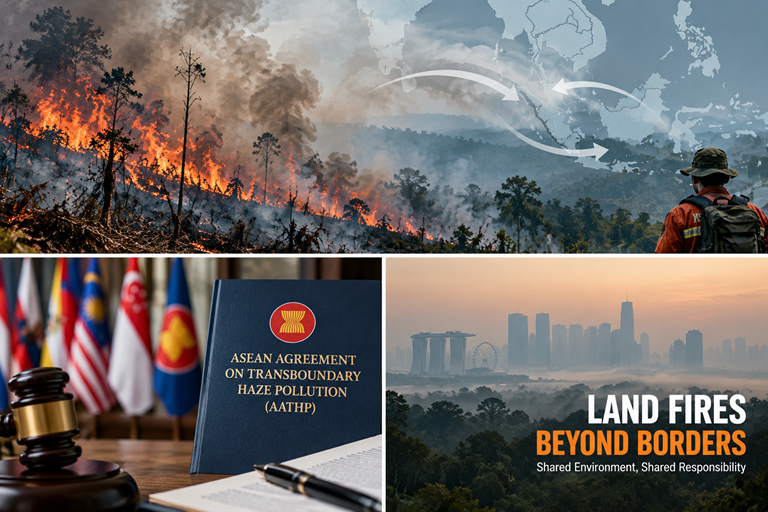
YOGYAKARTA, Indonesia—The Base for International Law and ASEAN Legal Studies (BILALS) has called on the Indonesian government to strengthen its compliance with the ASEAN Agreement on Transboundary Haze Pollution (AATHP) amid recurring forest and land fires in Kalimantan, Sumatra, and other parts of Indonesia.
The recurrence of forest and land fires (kebakaran hutan dan lahan or karhutla) demonstrates the continuing need for stronger prevention, coordination, and enforcement mechanisms in Indonesia. The consequences of these fires are not confined within Indonesia’s territorial boundaries. Haze generated by large-scale fires has the potential to travel across national borders and affect neighboring ASEAN countries, particularly Malaysia and Singapore, creating environmental, public health, and socio-economic consequences.
President Prabowo Subianto has emphasized the importance of a rapid and coordinated response to forest and land fires during his inspection and visit to Kubu Raya Regency, West Kalimantan. Effective coordination is particularly important to ensure that fires can be brought under control before they expand into wider areas and potentially generate transboundary environmental impacts. Director of BILALS, Dodik Setiawan Nur Heriyanto, S.H., M.H., LL.M., Ph.D., expressed concern that Indonesia’s inability to adequately prevent and control recurring forest fires could cause significant harm not only domestically but also beyond Indonesia’s borders.
According to Dodik, the issue must therefore be understood not merely as a matter of domestic environmental governance but also as one involving Indonesia’s obligations under international and ASEAN law. “From the perspective of international law, Indonesia has an obligation to prevent activities within its territory from causing significant environmental harm to other States. Forest and land fires are not a new phenomenon in Indonesia. Their recurring nature means that the Government should already have sufficient experience, data, and institutional capacity to identify high-risk areas and potential hotspots before fires develop into large-scale environmental disasters.”
He stressed that the Indonesian Government must shift its approach from predominantly reactive firefighting towards prevention, early detection, mitigation, and rapid response. This requires effective monitoring of hotspots, stronger coordination between central and regional authorities, adequate firefighting infrastructure, and effective enforcement against individuals and corporations responsible for illegal burning.
The regional legal framework for addressing this problem has existed for more than two decades. The ASEAN Agreement on Transboundary Haze Pollution was signed in Kuala Lumpur on 10 June 2002 and entered into force in 2003. Indonesia subsequently ratified the Agreement in 2014 through Law No. 26 of 2014, making Indonesia the last ASEAN Member State at that time to ratify the regional agreement.
BILALS considers Indonesia’s compliance with the AATHP particularly important given the country’s strategic position in ASEAN and its significant role in regional environmental governance.
Under the Agreement, State Parties undertake obligations to prevent and monitor transboundary haze pollution resulting from land and forest fires, mitigate its impacts, and strengthen national and regional cooperation. Accordingly, Indonesia’s responsibility cannot be limited to extinguishing fires after they have become uncontrollable. The regional framework requires a preventive approach capable of reducing the likelihood that domestic forest and land fires develop into transboundary haze pollution. “Ratification must not merely represent Indonesia’s formal commitment on paper. The most important question is whether the obligations contained in the ASEAN Agreement are effectively translated into national prevention mechanisms, law enforcement, institutional coordination, and concrete measures on the ground,” Dodik explained.
Although the AATHP relies heavily on cooperation, consultation, information sharing, monitoring, and mutual assistance rather than a strong punitive enforcement mechanism, persistent transboundary haze can nevertheless create significant diplomatic and regional accountability pressures for Indonesia. Other affected ASEAN Member States may raise concerns through ASEAN mechanisms and diplomatic channels and demand stronger preventive and remedial measures.
BILALS also highlights the importance of investigating the underlying causes of forest and land fires rather than treating haze solely as a natural or seasonal phenomenon. Particular attention must be given to fires associated with deliberate land clearing and commercial activities. Where investigations establish that corporations, concession holders, or other actors have intentionally or negligently contributed to forest and land fires, Indonesian authorities must ensure effective enforcement of environmental, forestry, plantation, and other applicable laws.
According to Dodik, economic development and the expansion of the palm oil industry cannot justify practices that destroy forest ecosystems or generate environmental consequences extending beyond Indonesia’s national borders. “Indonesia must demonstrate that economic development, including the palm oil industry, operates within the boundaries of environmental law. Where companies deliberately use fire to clear land or illegally obtain access to forest areas, the Government must take firm legal action. Corporate economic interests cannot be placed above environmental protection, public health, and Indonesia’s international obligations.”
For BILALS, the recurring transboundary haze problem should therefore serve as an important reminder that environmental sovereignty is accompanied by international responsibility. Indonesia retains sovereign authority over its forests and natural resources, but the exercise of that sovereignty must take into account environmental consequences that may affect other States. BILALS consequently urges the Indonesian Government to strengthen hotspot monitoring and early-warning systems, improve coordination among national and regional authorities, provide adequate infrastructure for forest-fire prevention and suppression, and ensure rigorous enforcement against parties responsible for illegal burning.
More importantly, Indonesia should demonstrate that its commitment to the ASEAN Agreement on Transboundary Haze Pollution extends beyond formal ratification and is reflected in effective measures to prevent transboundary environmental harm.
Effective implementation of the AATHP would not only protect Indonesia’s forests and communities but would also demonstrate Indonesia’s commitment to responsible environmental governance and reinforce its credibility as a leading member of ASEAN.